
Every Cornea Counts
The Critical Need for Advanced Preservation
The Global Challenge
Corneal blindness affects millions worldwide, yet fewer than one in 70 people in need receives a transplant. The disparity between supply and demand places immense pressure on eye banks to maximize the utility of every donated cornea.
Effective preservation is not just about extending storage time—it’s about maintaining tissue quality, enabling precise surgical planning, and ultimately improving patient outcomes. When preservation fails, viable tissue is lost, surgical schedules are disrupted, and patients continue to wait.
The Evolution of Corneal Storage
For three decades, hypothermic storage has been the gold standard in corneal preservation. While traditional media have served the field well, they were developed with the limitations of 1990s technology and understanding.
Modern corneal surgery has evolved dramatically—ultrathin DSAEK grafts, delicate DMEK procedures, and international tissue distribution demand more from preservation media. The question is no longer just “Can we keep tissue viable?” but “Can we preserve tissue in a way that optimizes every aspect of the corneal journey?“
What Makes XTRA4 Different
Dextran-Free Formulation Traditional storage media rely on dextran as a deswelling agent, but research has raised concerns about its uptake by corneal tissue. XTRA4 eliminates dextran entirely, using a carefully optimized alternative that maintains corneal thickness without potential tissue interaction.
Comprehensive Nutritional Support
XTRA4 provides corneal tissue with everything needed for extended preservation:
- Vitamins and amino acids for cellular metabolism
- Sodium pyruvate as an ATP precursor for energy production
- Optimized buffering system (MEM and sodium bicarbonate) maintaining physiological pH
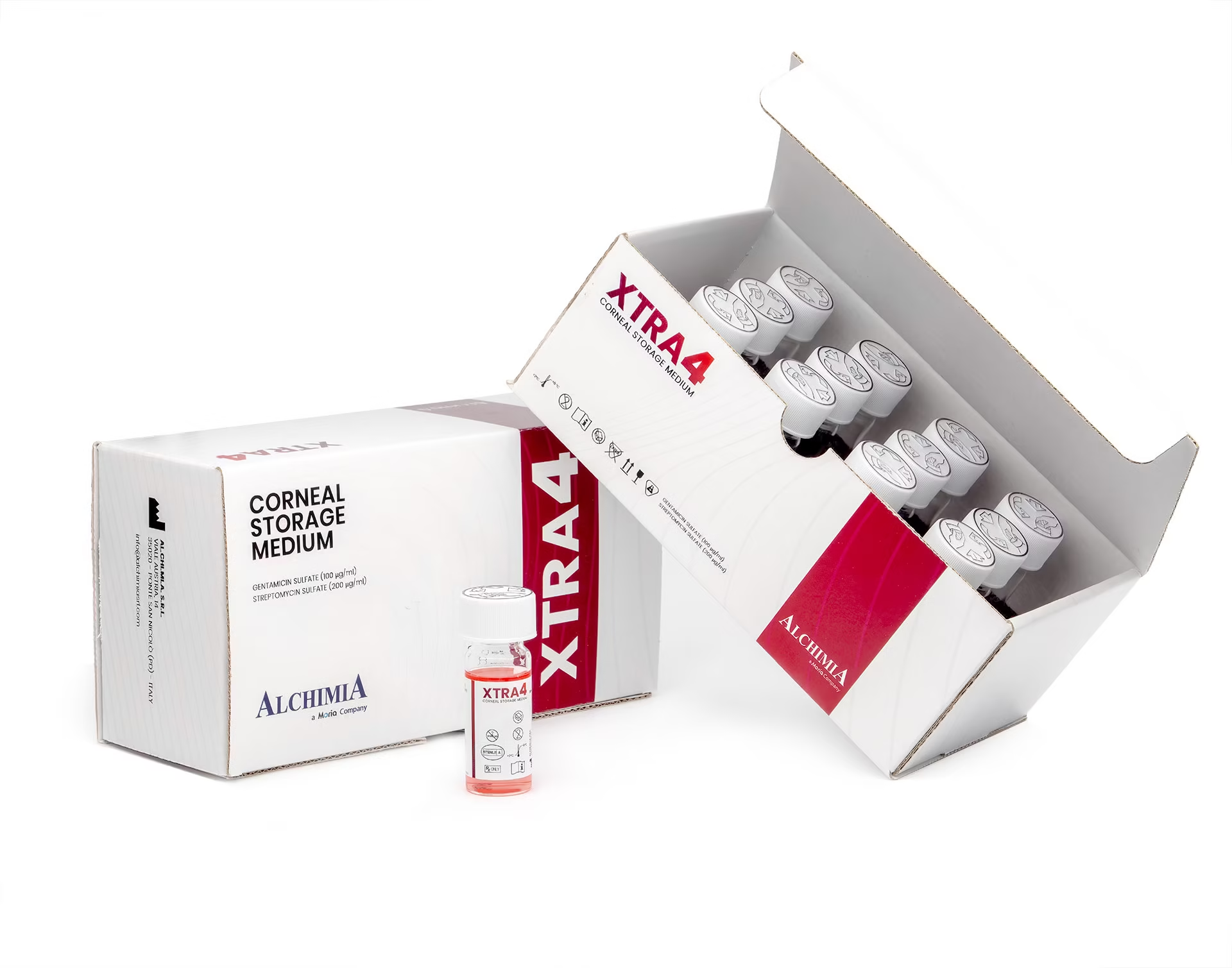
- Broad-spectrum antimicrobial protection (gentamicin and streptomycin sulfate)
Osmotic Balance
The formulation maintains iso-osmolarity (255-345 mOsm/kg), preventing excessive fluid shifts that lead to stromal swelling and endothelial stress.
The R&D Process: Hundreds of Prototypes, One Solution
Dr. Jana D. Tóthová, from Moria’s R&D team, describes the development process: “We developed hundreds of prototypes and tested several alternatives for essential components. XTRA4 is a rich, carefully optimized formulation that was only finalized after extensive experimentation to identify the most effective ingredient of the highest quality.”
This iterative approach included:
- Accelerated aging studies confirming 2-year shelf-life stability
- Comprehensive biocompatibility testing (cytotoxicity, skin sensitization, ocular irritation)
- Independent validation at three leading eye banks across two continents
Independent Validation
XTRA4’s performance has been rigorously evaluated by:
- VisionGift (Portland, Oregon) Supported by a High Impact Grant from the Eye Bank Association of America, researchers evaluated XTRA4’s potential for extended storage, with findings presented at major international conferences.
- Eversight (Cleveland, Ohio) Conducted comparative studies focusing on DSAEK graft preparation, demonstrating consistent thickness profiles and superior tissue handling characteristics.
- Fondazione Banca degli Occhi del Veneto (Venice, Italy) Evaluated XTRA4 performance in European eye banking contexts, confirming results across different operational protocols and tissue preparation methods.
Key Innovation Outcomes
Stable Thickness Profile – Unlike traditional media where corneas progressively thicken during storage, XTRA4-preserved tissue maintains near-baseline thickness. Average central corneal thickness increases by just 2.4% over 14 days, compared to 10% with Optisol-GS®.
Epithelium-Independent Preservation – Even when the epithelium is compromised—a common challenge in eye banking—XTRA4-stored corneas resist stromal swelling and maintain clarity. This resilience provides practical advantages in tissue assessment and handling.
Setting New Standards
XTRA4 represents more than incremental improvement—it’s a fundamental rethinking of what corneal storage media should achieve. By addressing the real-world challenges faced by eye banks and surgeons, it establishes a new benchmark for tissue preservation in the modern era of corneal transplantation
For Patients
Every day matters when living with corneal blindness. Advanced preservation technologies expand access to sight-restoring procedures by:
- Increasing the pool of suitable donor tissue
- Optimising donor and recipient tissue matching
- Supporting more predictable surgical outcomes
- Reducing the need for repeat procedures
For Eye Banks
Eye banking requires solutions that support operational efficiency while maintaining the highest quality standards:
- Tissue Assessment: Clear visualization enables accurate endothelial cell counts and morphology evaluation
- Inventory Management: Extended storage windows provide greater flexibility in tissue allocation
- Quality Control: Stable tissue characteristics throughout storage ensure consistent standards
- Global Distribution: Reliable preservation supports international tissue sharing programs
For Surgeons
Surgical success begins with tissue quality. Optimal preservation supports:
- Predictable graft thickness for endothelial keratoplasty procedures
- Minimal stromal distortion for smoother DMEK preparation
- Reduced risk of intraoperative complications
- Better postoperative visual outcomes
The Supply Chain Challenge
Recent years have highlighted the vulnerability of corneal storage supply chains. The COVID-19 pandemic caused widespread shortages of traditional storage media, and subsequent product discontinuations further disrupted the field. These events resulted in:
- Significant reduction in transplant volumes
- Increased pressure on international tissue distribution
- Growing recognition of the need for sustainable, scalable solutions
Moving Forward
The future of corneal transplantation depends on preservation technologies that can meet growing demand while improving tissue quality. This requires solutions that are:
- Scientifically validated through independent research
- Operationally practical for diverse eye bank settings
- Clinically superior in maintaining tissue viability
- Globally scalable to support international distribution